01
Citation-first UX
The answer and its evidence were designed as one interaction, making verification a normal part of use.
CASE / 02 · Windrose product · research copilot
Our own research copilot turns papers into citation-grounded answers and connected knowledge, combining retrieval with a graph of the entities and claims inside the corpus.
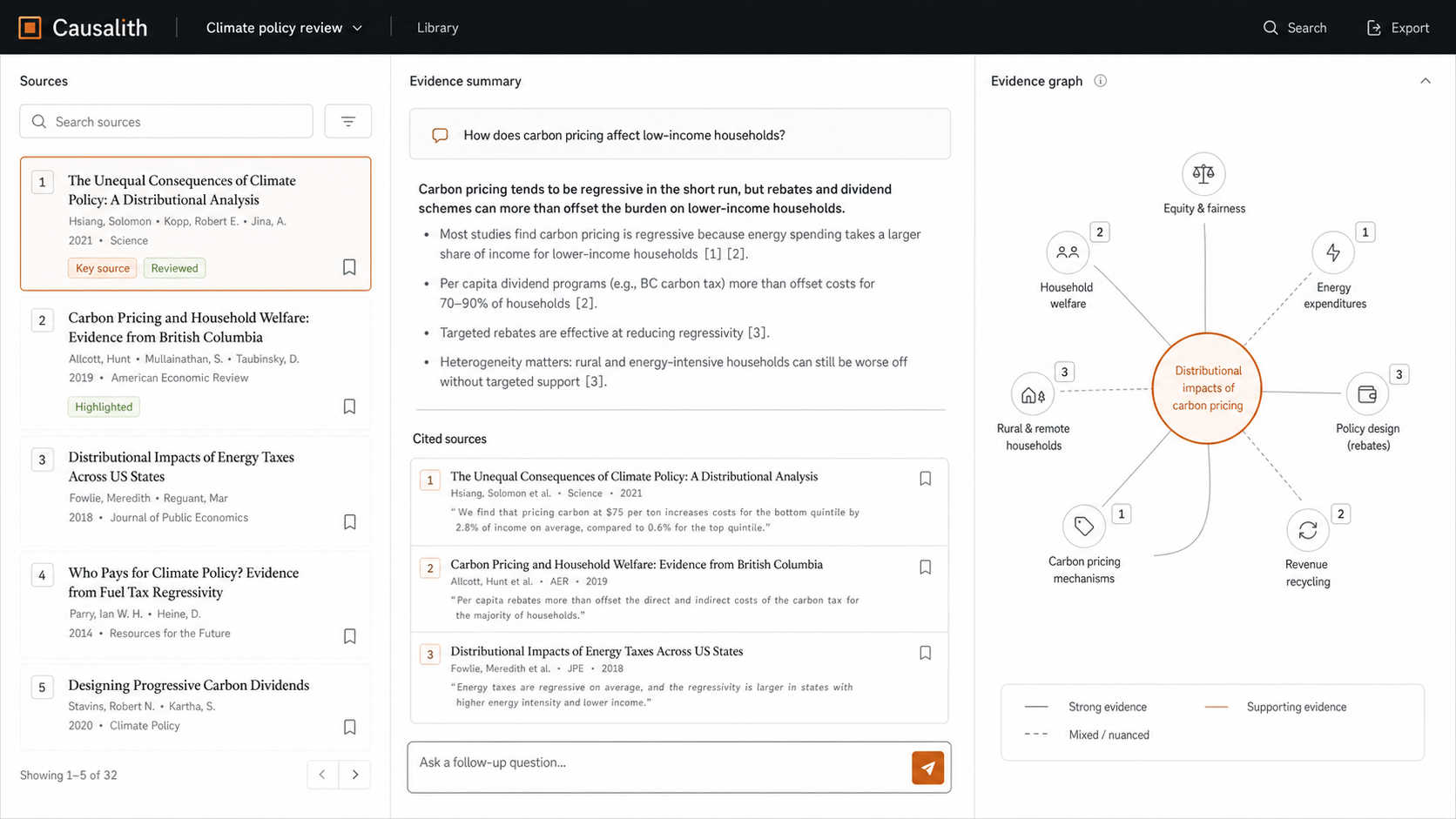
General-purpose assistants can summarize quickly, but research work breaks when the source of a claim is unclear or the system loses the relationships between papers, entities, and ideas. Causalith needed to make a large corpus searchable without flattening it into anonymous chunks—and it needed to keep the evidence visible inside every useful answer.
We built the ingestion pipeline, retrieval layer, Neo4j graph construction, answer generation, citation experience, and product interface in-house. Papers are parsed, cleaned, chunked, and embedded; entities and claims are lifted into a graph; and each question retrieves the most relevant passages and connected context before an answer is generated. The interface keeps citations close enough to inspect instead of hiding provenance behind a generic response.
Causalith demonstrates the Windrose approach to production AI: retrieval quality, graph context, citations, and interface decisions are treated as one product system. It is live at causalith.com ↗.
/02 — Engineering decisions
The strongest AI product decisions are often invisible to the user. These were the boundaries that kept the system coherent, maintainable, and ready for real use.
The answer and its evidence were designed as one interaction, making verification a normal part of use.
Vector retrieval handles semantic relevance while graph context preserves useful relationships across the corpus.
The system exposes source passages instead of asking users to trust a confident paragraph with no trail.
Ingestion, retrieval, graph enrichment, and generation remain separate enough to diagnose and improve.
/03 — Continue exploring
Explore the capabilities behind this product and how we approach a focused MVP launch.
We get your MVP live in 30 days or you don't pay. Tell us your idea and who it is for. We will reply within one business day to help shape your launch plan.
Let's launch your MVP ↗Scope, launch criteria, and kickoff agreed before the build. How the guarantee works.